
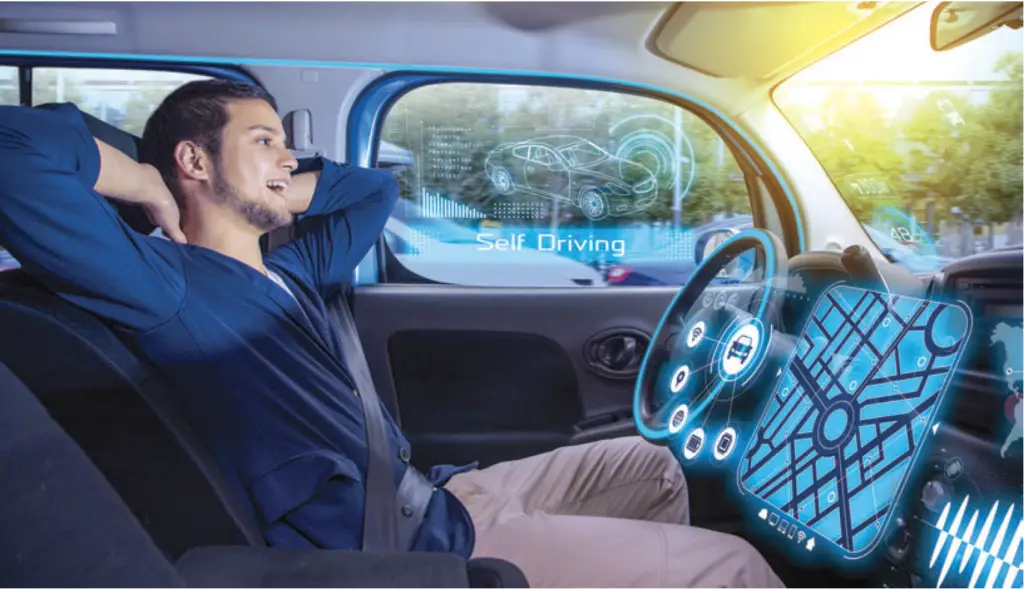
Environmental policy lit the spark for electric vehicles, but technology is fanning the flame. The coming wave of self-driving, software-defined mobility will change how collision shops operate.
Written by Ken Hendricks
The electric vehicle has been framed as a moral choice — a way to save the planet from smog-producing combustion engines. Governments offered rebates, set targets, and warned of climate catastrophe, offering carrots along with the stick. Fear has always been a powerful motivator for humanity, from Y2K to nuclear winter and climate change.
Considering all those Terminator movies and the current advances in artificial intelligence, AI takeover scenarios have become the latest in that lineage.
But history tells us that technology rarely advances out of virtue. It moves forward because it works better. The truth is — EVs will not thrive because of government policy or moral pressure; they will thrive because automation demands electricity.
The adoption of self-driving technology will represent the biggest transformation in mobility since the invention of the horseless carriage. Vehicles are becoming intelligent, connected, and increasingly independent — computers on wheels that think and react faster than humans ever could. And that evolution requires a different kind of power source.
The internal combustion engine is a marvel of the past, but it’s a mechanical organism trying to exist in a digital world.
Automation, by contrast, is a creature of code. It needs instant and precise control — something only electrical power can deliver. An electric motor reacts in milliseconds, operates without gears or vibration, and offers the smooth predictability required for self-driving vehicles.
That’s why every major player in automation — whether it’s Waymo, Cruise, Zoox, or Tesla – has gone electric. Even Nissan captured this truth in a humorous ad that imagined everyday appliances running on gas: a gasoline-powered toothbrush, a chugging blender, and a sputtering vacuum. The absurdity drove home a simple point: electricity is the logical language of digital machines. And if you’re going to trust a car to drive you to work while you check email, it should probably speak that language fluently.
But the deeper transformation isn’t just how cars are powered but how they’re used, because once fully autonomous vehicles become practical and affordable, personal car ownership will look inefficient and even downright antiquated. Why buy something that spends most of its life parked when you can summon a clean, quiet, driverless car that arrives at your door, delivers you safely, and takes you where you need to go?
In their article “Shared mobility: Sustainable cities, shared destinies,” McKinsey & Company projects that by 2030, private‐vehicle usage in urban areas is likely to drop significantly, replaced in part by shared and autonomous fleets powered by electricity. Electricity is cheaper per kilometre, has lower maintenance costs, and results in minimal downtime. Digital updates keep vehicles smart and safe without ever visiting a service bay.
Once automation reaches maturity, gasoline simply can’t compete.
We can already see the emergence of this new mobility economy. Amazon’s Zoox is building fully autonomous EVs without steering wheels or pedals. Tesla’s long-term vision is a self-driving, ride-hailing network powered by its existing fleet. Waymo and Cruise are operating pilot services in several U.S. cities. Even legacy automakers like Ford and Hyundai are developing EV-first autonomy platforms.
The current challenges
None of this means the EV transition is without uncertainty. Charging infrastructure remains uneven, especially in rural areas. Range anxiety still deters buyers, and battery degradation — though improving — continues to raise concerns regarding longevity and resale value. A new battery can cost $10,000 or more, and most EV models depreciate faster than their gas-powered counterparts.
Why buy something that spends most of its life parked when you can summon a clean, quiet, driverless car that arrives at your door, delivers you safely, and takes you where you need to go?”
Yet these are transitional issues, not permanent obstacles. More importantly, as ownership models shift from individual drivers to shared fleets, the burden of depreciation and repair moves off the consumer. When you summon an autonomous EV instead of owning one, battery health isn’t your problem.
The cultural shift
Younger generations already see the road ahead differently. Nearly half of Canadians under 35 say they’d give up owning a car if reliable automated transport were available. In crowded cities where parking, insurance, and congestion are daily frustrations, flexibility has replaced ownership as a symbol of freedom. When the next wave of self-driving EVs arrives, it will feel like the next logical step.
Two revolutions, one road ahead
For the automotive aftermarket, this convergence of electrification and automation represents not one revolution but two.
The first wave — electrification — is already changing how we service and recycle vehicles. Shops are learning to handle high-voltage systems safely, recyclers are managing end-of-life batteries, and towers are adapting to new EV recovery protocols when bringing these vehicles to collision shops.
The second wave — automation — will redefine who owns vehicles, how often they’re used, and how they’re maintained. Fleet management will replace a large percentage of private ownership. Repairs will be scheduled predictively rather than reactively. Vehicles will self-diagnose problems before they fail, and the moment a system error occurs, the repair shop will be alerted.
The industry that once turned wrenches will soon turn algorithms.
At EVfriendly, we see this transformation not as a disruption, but as an evolution. Our role is to help the industry adapt and to prepare recyclers and repairers for vehicles that are more computer than machine. That means training, education, and readiness for the digital road ahead. ■