
As electric vehicles surge into the mainstream, one B.C. repairer is redefining what it means to be “independent.”
Written by Ken Hendricks
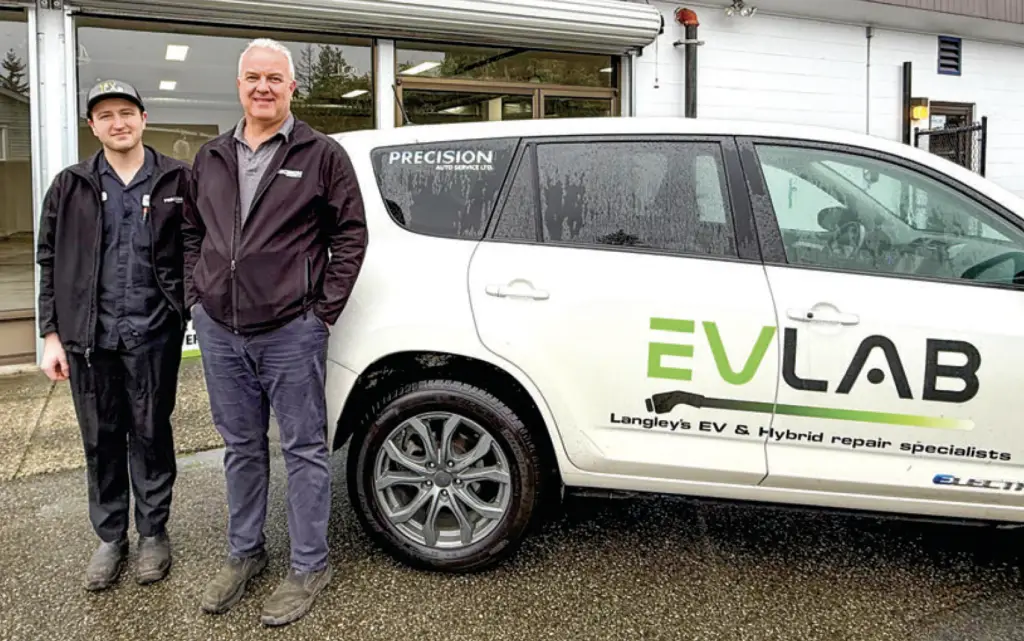
Scott Waddle (right) and his son Michael at EV Lab’s Langley site, pioneering a new model for independent EV and hybrid repair. (Photo courtesy of Scott Waddle)
When Scott Waddle opened EV Lab in Langley, B.C., earlier this year, he wasn’t just starting another auto repair shop — he was building a bridge to the future. After years of operating Precision Auto Service, Waddle saw what many others in the trade chose to ignore: a massive shift in the automotive sector.
“The traditional automotive aftermarket has had little interest in serving this growing market,” Waddle said of electric and hybrid vehicles. “But the opportunity was too great to ignore.”
The inspiration, he admits, came partly from his son Michael, whose curiosity about electric vehicles at a young age sparked the family’s deeper involvement. “He was fascinated by EVs when he was about 10,” Waddle recalls. “Now he’s 22, trained at BCIT, and part of the new generation helping drive this change.”
From precision to EV Lab
The concept for EV Lab evolved through years of groundwork at Precision Auto, where Waddle’s team began servicing electric vehicles as early as 2016. “We bought our first Nissan Leaf back then and started learning
from the inside out,” he said. “It was clear this was where the future was headed.”
The name EV Lab was inspired by a collaboration with Victoria-based Rand Automotive, another ARA member. Rand’s owner, Jerry Rand, coined the name when he launched EV Lab Victoria, a sister operation that shares branding and marketing strategies with Waddle’s Langley location. “It’s not a franchise,” Waddle clarifies, “but we’re aligned on vision. We lead on the technical side — they lead on marketing.”
Together they form a small but growing network of like-minded independents willing to take the leap into EV specialization.
A market ripe for innovation
Independent EV repair facilities remain rare in B.C. In fact, only a handful are fully dedicated to the field. “For years, most shops simply steered customers away from EVs,” Waddle explained. “They told them not to buy one because the batteries would fail, they’d be too expensive, or there’d be nowhere to charge them. But that narrative’s collapsing. EVs are everywhere now.”
While dealerships still dominate the repair of newer EVs, Waddle believes independents will become essential as vehicles age out of warranty. “There’s a huge wave of out-of-warranty EVs coming,” he said. “They’ll need affordable, safe, and innovative service options, and that’s where independents will thrive.”
Still, he acknowledges that manufacturers have made it difficult.
“Some OEMs restrict EV components like batteries from being sold to the aftermarket,” he said. “We’ve had to get creative, sometimes sourcing parts overseas or even identifying and buying components from the original supplier to the supplier.”
In one notable example, EV Lab was able to purchase restricted Volkswagen EV battery parts only after presenting BCIT training credentials to prove their technicians’ qualifications. “That opened the door,” Waddle said. “Training is the key.”
Tools, training and the “new normal” of auto repair
Contrary to popular belief, opening an EV-specific shop doesn’t require a complete reinvention of the repair shop. “Most of what you need, a good shop already has,” Waddle said. “There are some specialized meters, gloves, lifting tables and ideally, a forklift. But beyond that, it’s about know-how and safety.”
He points to the growing role of formal training programs like those offered by BCIT and Vancouver Community College as crucial to bridging the gap between OEM restrictions and independent capability. Both Waddle and his technicians have completed advanced EV service training through BCIT, and he continues to advocate for stronger collaboration between schools and industry.
But technical knowledge is only part of the solution. “You also need curiosity and courage,” Waddle said. “EV systems are different, but they’re not magic. The aftermarket has always had to be resourceful — this is just the next chapter of that story.”
Consumer education: battling misconceptions
If there’s one area where Waddle sees the most work ahead, it’s in education. “There’s a perception that EVs have no maintenance needs,” he said. “That’s partly true as there are fewer moving parts in an EV, but it’s not maintenance-free. It just happens later in the vehicle’s life.”
That lag, he explains, can create problems. “People think, ‘My EV doesn’t need anything,’ until year eight when the HVAC or charging system fails. Those are expensive systems to fix. Education is critical.”
Using social media as a key outreach tool, EV Lab shares maintenance tips and myth-busting information about EV ownership. “We’re part of a movement to normalize EV care,” Waddle said. “If we can help owners understand their vehicles better, we’re doing our job.”
Community and collaboration
Community has always been central to Waddle’s business philosophy. Through partnerships with local colleges and programs like EVfriendly, he’s helping develop the next generation of EV technicians. “We need apprentices who are excited about this technology,” he said. “Finding people who want to learn EV repair isn’t easy, but when you do, it’s worth it.”
Waddle is also part of several grassroots networks that share information across North America. “We talk with shops from B.C. to California every week,” he said. “We share what works, what doesn’t, and how to source hard-to-find parts. You get what you give — it’s all about collaboration.”
That spirit of openness, he believes, is essential for the aftermarket to survive in the EV era. “Too many people still think sharing knowledge is weakness. It’s not. The only way we all get better is together.”
A growing sector and a word of advice
Looking ahead, Waddle predicts rapid growth for independent EV repair over the next five years. “Right now, there are maybe three dedicated EV-only shops in the province. There is ours in Langley, EV Lab in Victoria and Factory E in Vancouver,” he said. “But that’ll change fast.”
There’s a huge wave of out-of-warranty EVs coming… They’ll need affordable, safe and innovative service options, and that’s where independents will thrive.”
He points to programs like NAPA’s Next Drive as early attempts to mobilize independents, though uptake has been slower than expected. “There’s interest,” he said, “but people are still cautious. They’re waiting for the market to prove itself. It already has.”
Scott’s advice for others? “First, hire or become someone who truly wants to do this,” he said. “You can’t force an ICE (internal combustion engine) tech to become an EV tech; it’s a different mindset. Second, network relentlessly. You won’t keep up without using the collective brainpower of others.”
As he reflects on the early days of EV Lab — temporary signage still on the building and a new logoed car in the lot — Waddle knows he’s building something that’s bigger than a business. “This isn’t just about repairing cars,” he said. “It’s about shaping the future of the aftermarket.”
From the outside, EV Lab may look like a small shop in Langley, but what’s happening inside represents a seismic shift in Canadian automotive culture: a move from mechanical to electrical, from routine maintenance to innovative solutions, and from competition to collaboration.
In that sense, the name “EV Lab” couldn’t be more fitting; it’s not just a repair facility — it’s a laboratory in what the independent repair shop of the future will look like. ■