
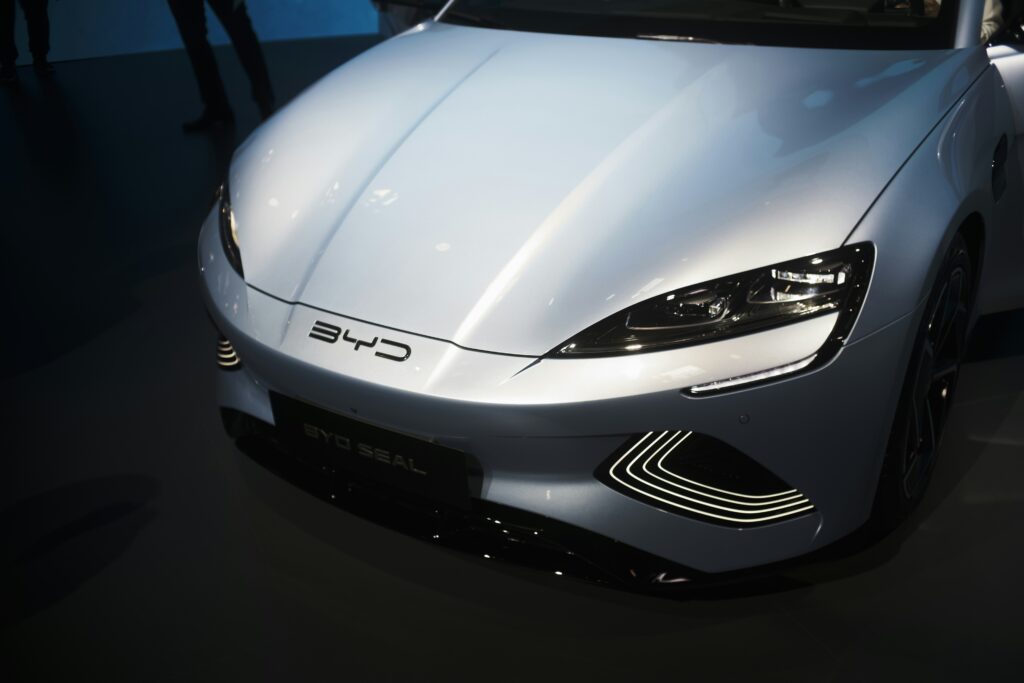
Chinese EV brands are expanding globally and could enter Canada under the new tariff quota, raising practical questions about service networks, parts access and repair readiness.
Written by Ken Hendricks
Canada has reopened the door to Chinese-made EVs. For collision shops, technicians, tow operators and recyclers, the concern isn’t geopolitics — it’s the impact of unfamiliar brands arriving without established service networks, parts supply chains, repair data access or end-of-life battery frameworks.
What just shifted in Canada’s EV landscape — and why should it matter to you?
Ottawa’s new agreement with China effectively restarts imports of Chinese-made electric vehicles, reducing tariffs to 6.1 per cent on a defined quota of vehicles after Canada imposed a 100 per cent duty in 2024.
The agreement allows up to 49,000 vehicles per year under the lower tariff, rising to 70,000 annually by year five. Government statements and third-party commentary suggest a pricing objective as well: part of the quota is intended for EVs with an import price of $35,000 or less, a threshold designed to improve affordability and boost adoption.
Put those numbers in perspective
At first glance, 49,000 vehicles may sound significant — until you compare that figure with the Canadian new-vehicle market. Reuters and other coverage estimate the quota represents less than three per cent of Canada’s annual new-vehicle sales. Canada’s annual market has hovered above one million units, with some forecasts projecting 1.8 to 1.9 million light vehicles in 2025.
So why is a three per cent change such a big deal?
Aftermarket disruption isn’t linear. A small number of vehicles can create outsized impact if they introduce:
- Unfamiliar repair procedures and calibration requirements
- Uncertain parts availability
- Limited OEM service footprint (especially outside major centres)
- Unclear data access and security policies
- Evolving battery chemistries with unclear end-of-life pathways
The “service-network problem” is real. If Chinese-branded EVs only arrive in limited volume, the business case for a coast-to-coast dealer and service footprint becomes weaker. That typically means a concentration in major urban centres and patchy support elsewhere, raising the likelihood of longer tows, extended wait times and more improvisation by independent repairers and tow operators.
Many in the industry still remember the early days of EV servicing gaps, when owners faced long distances to access specialized service. With Chinese brands, the risk could be similar but multiplied across several new makes.
Price as an EV growth incentive — and potentially misleading MSRP
Cheaper EVs could be exactly what Canada needs right now. ZEV market share has been volatile, and recent quarters have softened compared with the late-2024 surge. The logic behind a $35,000 entry-level tier is straightforward: more mainstream buyers may be able to switch to EVs.
But the aftermarket should be careful about one assumption: cheaper to buy does not necessarily mean cheaper to own or cheaper to repair. Here are the unknowns worth considering — albeit speculative at this stage:
1. Repair-cost realities
If parts are scarce or expensive to ship, collision severity does not have to be high for a vehicle to tip into total-loss territory. Cycle time quickly becomes a major cost driver.
2. Battery durability and replacement economics
Many Chinese EVs are widely reported to be “good cars,” but Canadian conditions — winter weather, reduced range, road salt, long-distance driving and charging infrastructure — may stress vehicle systems differently. If Chinese EVs are not economically serviceable outside OEM channels, the total life-cycle value proposition could shift.
3. Resale and salvage value
A low Manufacturer’s Suggested Retail Price (MSRP) can be undermined by low resale confidence if buyers worry about parts, software access or battery health verification — concerns that also matter to insurers, fleets and recyclers.
In other words: price can accelerate EV adoption, but ownership economics determine whether that adoption sticks.
What changes, and what stays the same? It’s just a car — until it breaks.
A Chinese EV is still a car. It will still need tires, glass, alignment, brakes, suspension components, towing after collisions and end-of-life processing. The pressure points are typically information, parts and software access. Here is how the impact is likely to unfold:
Years 0–2: Collision and towing come first
- Collisions happen on Day 1 — even while vehicles are under warranty.
- Tow operators face unfamiliar safe handling requirements, including disablement, storage and damaged battery protocols.
- Body shops navigate unfamiliar procedures, calibration and parts-flow challenges.
Years 2–5: Mechanical pressure begins to build
- Warranty coverage thins; owners begin turning to independent shops.
- Diagnostic and calibration capability become a competitive differentiator.
- Parts sourcing and OEM repair-data access become recurring issues.
Years 5+: End-of-life pressures intensify
- More total losses and auction vehicles enter the pipeline.
- Battery health triage, second-life decisions and recycling capacity become central business issues — not just peripheral projects.
Without the support of a government or industry-regulated framework for end-of-life batteries, collection and disposal become major challenges.
This staging matters because it tells you where Chinese EVs will have their first impact, and how. They will affect collision readiness and towing protocols first, then diagnostic and calibration capability, then battery end-of-life handling, and finally industry partnerships — often before large-scale volume even arrives.
“Spy cars,” data custody and the scan-tool reality
The “spy car” label gets thrown around for political reasons, but it’s frequently more hype than reality. However, it does point to a practical issue the aftermarket must grapple with. Modern vehicles are data platforms, and the automotive ecosystem is still catching up to what that means.
Data custody becomes an aftermarket issue when vehicles pass through repossessions, auctions, salvage transfers, rebuilds and fleet decommissioning cycles. Who has the right (and ability) to clear personal data, transfer digital data or reset connected services?
These questions are already emerging with mainstream brands. New Chinese brands may amplify the problem if these systems are less familiar, or if Canada lacks clear end-of-life digital governance standards.
Diagnostics vs. theft: the security-access dilemma
Every year, independent technicians rely more on scan tools and secure functions to do legitimate work, yet thieves have also used similar tools to steal vehicles.
The industry response in the U.S. is instructive: the National Automotive Service Task Force (NASTF) Vehicle Security Professional (VSP) program vets and credentials eligible professionals, allowing them to access security-related services such as key programming and immobilizer resets through a secure registry.
Canada must find an equivalent trusted-access framework that protects vehicles without blocking legitimate repair. If security walls rise faster than credentialing frameworks, the result is predictable:
- More dealer-only restrictions
- More stranded vehicles waiting for keys or repairs
- Higher total loss rates for otherwise repairable vehicles
- Greater barriers to entry for independent operators
This isn’t solely a Chinese EV issue, but Chinese entrants could become a stress test for government to act.
Automation: Why Chinese EVs could accelerate the shift
Chinese automakers and China-based tech ecosystems have been aggressive in deploying “smart driving” and software-defined vehicle features, often treating ADAS and automation as a core part of product identity rather than a trim-level add-on.
What changes in the shop:
- More calibrations
- More scan events (pre- and post-scanning become the baseline)
- More software dependencies and subscription-style tool access
- Higher training intensity and more frequent update cycles
That creates a clear dividing line: automation expands revenue opportunities for capable shops while raising barriers to entry for everyone else.
Advanced battery technology — solid-state, new chemistries and recycling blind spots
China is a powerhouse in batteries and battery supply chains, and it’s reasonable to expect that Canadian-market vehicles could adopt newer chemistries as they mature. But here’s the practical point for the aftermarket: even today’s EV batteries outpace Canada’s end-of-life policy framework. We are effectively building the plane while flying it.
If solid-state (or semi-solid-state) batteries begin appearing in global markets later this decade, they could disrupt safe-handling assumptions, repairability (module-versus-pack strategies), recycling processes (materials-recovery economics) and transportation/storage requirements for damaged packs.
Even without solid-state, a large influx of any new EV population raises a question Canada has not fully answered: what is the standardized, enforceable pathway for battery management once vehicles leave first ownership? That answer directly affects towers, impound lot facilities, dismantlers and recyclers.
How can government support the potential influx of Chinese EVs?
If Canada wants affordable EVs without undermining serviceability and safety, government policy has to move beyond current guidelines and regulations.
1) Repair information access: CASIS requires modernization
Canada’s current approach for automotive service professionals relies heavily on a voluntary agreement called the Canadian Automotive Service Information Standard (CASIS), originally signed in 2009, intended to ensure aftermarket access to service and repair information comparable to that available to dealerships.
But 2026 vehicles are not 2009 vehicles. Today’s issues increasingly involve digital data, secure gateways, software functions, calibration procedures and account-linked ownership features.
New entrants — especially startups — may not feel compelled to participate in a voluntary standard. That’s why government should establish a regulatory backstop that sets minimum standards for service information, tooling access and secure-function pathways as a condition of selling vehicles at scale.
2) Security access frameworks for legitimate repair
Canada should support a vetted, standardized credentialing model — similar to the National Automotive Service Task Force (NASTF) Vehicle Security Professional program — so independent repairers can perform legitimate work while reducing theft risk.
3) Training and readiness funding
There must be targeted support for EV safety training, ADAS calibration capability, towing and recovery protocols for damaged EVs, as well as battery handling and storage best practices. This is infrastructure — not for charging but for repairability and safety.
4) Battery end-of-life rules
Canada needs clearer policy for damaged battery pack storage and movement, traceability and identification standards, and consistent, sustainable reuse and recycling pathways. Without it, the burden falls on the industry, often without clear authority, defined liability boundaries or cost recovery mechanisms.
Final thoughts
Even if the full 49,000-unit quota is reached annually, Chinese EVs will not “take over” Canada overnight. But they can still reshape the market because they affect the system where it is most fragile: parts logistics, information access, security, software and battery life-cycle management.
This is also where EVfriendly fits in. Our role is to keep the industry informed, translate technology into practical guidance, and work with stakeholders to develop training and resources so Canadian businesses remain safe, competitive and ready regardless of whose badge is on the hood.