
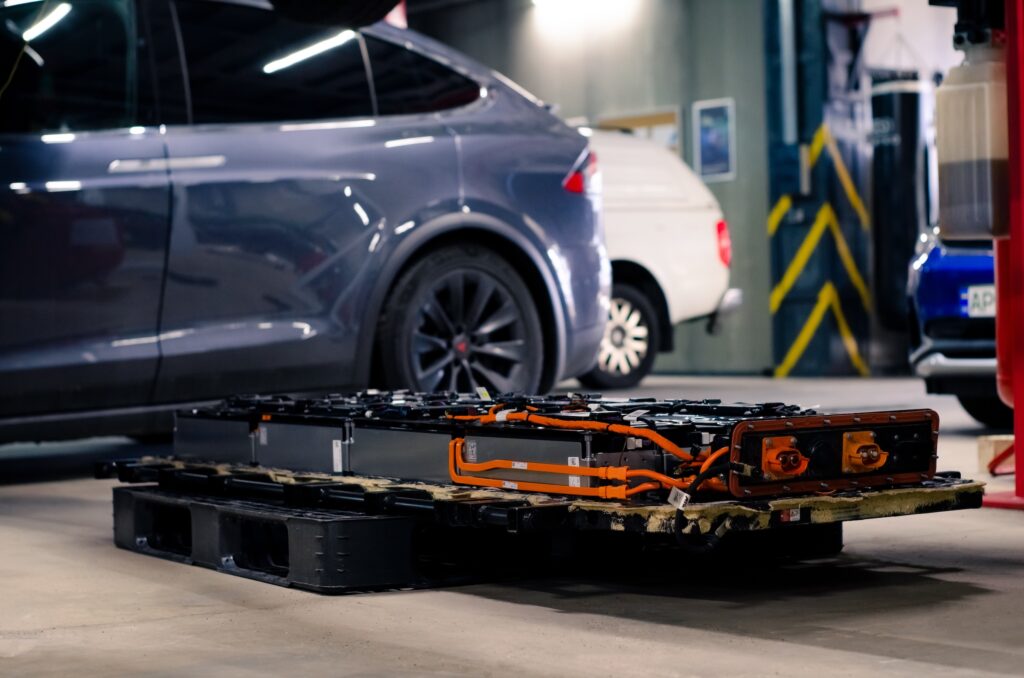
EV battery durability remains a growing concern for owners, repairers and insurers. Battery X Metals believes active rebalancing technology could offer a new solution. CEO Massimino Bellini Bressi explains how it works, why it matters and what it could mean for EV repair.
Written by Ken Hendricks
Battery X Metals is developing an active rebalancing system designed to restore performance, reduce premature write-offs and create a new service opportunity for the aftermarket.
Editor’s Note: EV battery durability remains a growing concern for owners, repairers and insurers. Battery X Metals believes active rebalancing technology could offer a new solution. CEO Massimino Bellini Bressi explains how it works, why it matters and what it could mean for EV repair.
The EV revolution has arrived, but with it comes an uncomfortable reality. While EV drivetrains are remarkably durable, the battery remains the most misunderstood, expensive and anxiety-inducing component. As EVs age, individual cells degrade unevenly, reducing range and performance. Replacement packs can cost more than the vehicle is worth, and many EVs involved in collisions or showing moderate degradation are written off, even when the battery could have been saved.
Battery X Metals, a Canadian company better known for mining and recycling research, believes this can change. The company has developed a new active battery rebalancing technology, currently in advanced prototype testing, that promises to restore balance between individual battery cells, improve performance and extend battery lifespan — in some cases, dramatically.
Massimino Bellini Bressi, CEO of Battery X, says the idea came from observing an emerging industry problem: Millions of EVs are now approaching or exiting warranty, with no standardized way to maintain their batteries.
“We want to change the status quo,” he says. “We want technicians looking at an aging EV battery and thinking, ‘If I treat it properly, this can perform significantly better.’ Exactly as it does with regular cars.”
A 360-degree approach to battery sustainability
Battery X operates with a circular-economy philosophy from end to end. The company runs mineral exploration projects and conducts research with the University of British Columbia on clean battery material recovery, and now — with its rebalancing innovation — it aims to extend the lifespan of EV batteries before recycling.
“We look for the minerals that go into batteries, we extend their lifespan and we help recycle them once they’re no longer useful,” says Bellini Bressi. “It’s a full 360-degree approach.”
Battery X’s rebalancing system is designed to operate on aging EV batteries at the cell level, restoring balance among hundreds of individual cells that naturally degrade at different rates over years of charging, discharging and idling.
The result is not a brand-new battery, but a significantly optimized one — like how tuning, cleaning or repairing components extend the life of an internal combustion engine.
Bellini Bressi describes it simply: “We see rebalancing as an oil change for EVs.”
The art of active rebalancing
Traditional “passive balancing” happens inside most EVs but works very slowly and only within narrow parameters. Battery X’s technology is different. The company’s external hardware module connects directly to the battery pack and performs active rebalancing, selectively working on individual cells or modules to restore uniformity.
“We’ll never return a battery to its day-one condition, because you can’t replace missing material,” says Bellini Bressi. “But we can put everything that’s still there back in its natural place, making the battery work at its best.”
Testing so far includes older Nissan LEAFs and electric trucks — which are particularly interesting because trucks often sit unused for long periods, creating significant imbalances within the pack. In early tests, Battery X reports restoring some packs to “virtually the initial capacity” — in some cases, slightly exceeding the original range. Although testing is still at the early stages, the batteries to date have shown measurable improvements.
National Research Council of Canada validation
To evaluate and verify the science, Battery X submitted its research and lab results to the National Research Council of Canada (NRC) — one of the most respected scientific institutions in the country. After a rigorous review, NRC validated the technology and its findings.
“There’s no better validation in Canada than NRC,” says Bellini Bressi. “Its approval gave us full confidence to bring this to market.”
NRC’s involvement may also help pave the way for recognition by automakers, insurers and regulators — all of whom require credible third-party data before adopting new repair practices.
A new repair category for the aftermarket
One of the biggest implications of rebalancing technology is its potential to create a new service category for repair shops: EV battery optimization and maintenance.
Most independent shops today don’t work on EV battery packs. The reasons are familiar: specialized training, high-voltage risks and a lack of standardized procedures. Battery X hopes to change this by making the process simple, safe and guided.
The newest prototype operates from a standard 120-volt wall plug and uses two linked modules that work independently to avoid excessive current or heat. The device moderates current down to safe limits and can detect cell-level abnormalities.
Battery X also envisions the rebalancing device becoming part of a standard diagnostic workflow:
- Assess: Measure the battery’s State of Health (SoH).
- Decide: Identify whether rebalancing is required.
- Recommend: Rebalance if moderate imbalance is present.
- Proceed: Recommend repair or replacement if you detect severe issues.
- Perform: Rebalance the battery and confirm the improvement.
Using this model, shops gain a new revenue stream, EV owners benefit from better performance and insurers gain more accurate SoH assessments.
Cost, insurance and repair implications
Battery X’s innovation arrives at a critical moment. Many EVs involved in collisions are written off not because the battery is damaged but because its condition is unknown, unverified or undervalued.
Even in the salvage marketplace, batteries are typically priced based on displayed range or unofficial testing.
Bellini Bressi offers a common example: A pack showing 73 per cent SoH might sell for $1,000 to $1,500. But after rebalancing, if the SoH climbs to 81 per cent, its resale value could easily more than double.
For insurers, better SoH data could mean fewer total-loss declarations and more accurate claim assessments. For recyclers and dismantlers, rebalancing adds value before selling batteries into the secondary market. For repairers, a formalized “battery recovery and optimization” step could become standard.
With millions of EVs leaving warranty, the repair industry will need tools like this to prevent unnecessary scrappage.
Environmental and sustainability benefits
The environmental impact of rebalancing is significant. If the lifespan of EV batteries can be extended even a few additional years, the reduction in waste and raw material demand would be substantial.
“Many EVs involved in collisions are written off not because the battery is damaged but because its condition is unknown.”
“We should take full advantage of what we own before purchasing something new,” says Bellini Bressi. “Millions of old EVs are on the road right now. We want drivers to get the best out of them before replacement.”
Battery X’s circular model ties it all together by mining for critical minerals, rebalancing to extend lifespan and recycling black mass using a clean froth-flotation process currently in R&D.
It’s an approach that emphasizes reuse, waste reduction and resource efficiency — key components of a sustainable EV future.
The road ahead
Looking five years ahead, Bellini Bressi believes battery rebalancing will become part of mainstream EV maintenance, helping owners protect the value of their vehicles while reducing premature waste. And, as Battery X continues refining this technology, the company is proud to work alongside EVfriendly to help promote, educate and support both industry and consumers as the EV landscape evolves. Together, the partners aim to chart a more sustainable, practical and accessible path forward for electric mobility.
“Once people see this procedure, it’s obvious,” he says. “A decade ago, wireless headphones seemed futuristic. Technology evolves quickly. EV maintenance will, too.”