
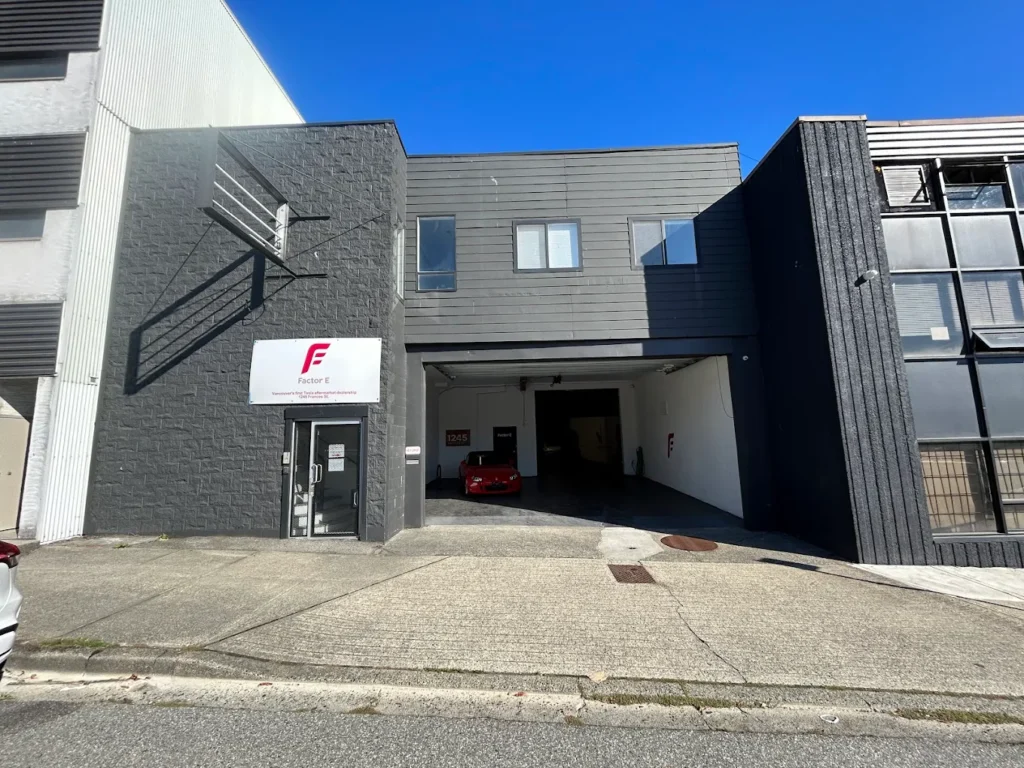
As EVs move deeper into the mainstream, Factor E is proving that independent EV repair can be practical and profitable — and built for long-term growth
Written by Ken Hendricks
When Sean Thompson talks about electric vehicles, he doesn’t sound like someone chasing a trend. He sounds like someone who has already arrived where much of the industry is still headed.
A fourth-generation “car guy,” Thompson grew up in the automotive world and spent the first half of his career in the internal combustion side of the business, eventually rising to senior service leadership roles with Honda Canada and Acura.
But when the first Teslas began reshaping expectations around performance, technology and vehicle design, he saw more than novelty. He saw a different future for repair.
“I didn’t get into it from the environmental point of view,” says Thompson. “I got into it because of performance.”
That early interest soon deepened into something more substantial. From the service side, he began to appreciate that EV repair was not simpler than traditional repair — it was simply different.
“It’s much more of a thinking process,” he says, describing the work as a blend of software, diagnostics and hands-on repair. “It’s a bit of an Easter egg hunt, and I enjoy that.”
That insight eventually became the foundation for Factor E, the Vancouver-based EV repair company that Thompson helped build alongside four former Tesla colleagues.
The company’s ownership group is unusual not just for its size, but for how closely it reflects the shop’s philosophy. Thompson describes the team as specialists, each focused on a different part of the business: diagnostics, high-voltage systems, sales and parts sourcing and overall business development.
All five worked together during Tesla’s formative years in British Columbia, and they brought that experience with them when they left to build something of their own.
“We’re five friends that built this business,” says Thompson. Factor E is not merely an independent repair shop that happens to work on EVs. It’s a purpose-built operation, created by individuals who saw a gap in the market and believed the aftermarket would eventually need to fill it.
For Thompson, that gap became obvious after working inside the OEM EV environment. There remains, he says, a widespread belief among both consumers and the industry that EVs need little or no service. But his experience told him otherwise.
“These cars do need service,” he says, “but it’s much more repair-oriented.”
In his view, the industry is moving away from old maintenance-heavy models and back toward true diagnostics and repair, only now with batteries, firmware, electronics and high-voltage systems at the centre of the work.
This shift is precisely what makes EV-only facilities both promising and challenging.
On the one hand, Thompson sees enormous opportunity. As EVs age out of warranty, more owners will need alternatives to dealership service networks.
On the other hand, operating an all- EV shop comes with real barriers: limited training pathways, difficulty accessing parts, the challenge of building a profitable repair model and the ongoing need to educate both customers and technicians about what EV service actually involves.
Thompson is frank about all of it.
“I think that’s actually the biggest gap,” he says, pointing to training, parts access and the business side of making EV repair profitable.
That’s one reason why Factor E is evolving beyond service alone. Thompson says the company increasingly sees itself not just as a repair facility, but as a growing parts distribution business focused initially on Tesla and, eventually, on the wider EV market.
Over the last year, the company has expanded its importing of mechanical parts and begun sourcing body panels and other components for high-volume models such as the Model 3 and Model Y. Longer term, Thompson sees opportunity in battery remanufacturing, drive unit work and specialized EV parts supply — areas where traditional aftermarket channels are still thin.
In that sense, Factor E is pursuing a broader vision of what EV specialization can mean. Repair is part of the business, but so is infrastructure: parts, technical knowledge, training and support.
Training is a recurring theme in Thompson’s thinking. He’s realistic about how difficult it is to recruit experienced EV technicians. Good one are hard to find anywhere, he says, and even harder to find in the EV space.
Factor E has therefore found its “sweet spot” in younger apprentices and early-career technicians — people who are open-minded, eager to learn and willing to build their careers around a technology that still feels new to much of the industry.
He also draws a sharp distinction between the culture of EV repair and the flat-rate mindset common in many conventional shops. At Factor E, knowledge-sharing matters. The environment is designed to reward problem-solving rather than speed alone.
“We’re not in a flat-rate environment where we’re competing with one another,” he says. “There’s a lot of people helping each other out and sharing knowledge.”
That philosophy extends to customer service as well. In an industry increasingly shaped by apps, automation and low-contact service models, Factor E has made an intentional choice to be more personal. Thompson says EV owners often want to talk about their vehicles, their experiences and their questions, and his team wants to meet them there.
Unlike the more closed-off OEM model, Factor E encourages conversation, connection and transparency.
“We actually do want to talk to you,” he says. “We do want a relationship.”
One of the clearest examples of that philosophy is the company’s free tire rotation program. Thompson says the shop introduced it early on as a way of welcoming EV owners into a low-pressure environment and building long-term trust.
In his words, tire rotations in the EV world have largely “replaced the oil change” as the regular service interval that brings customers through the door. Rather than maximizing revenue from that visit, Factor E chose to use it to build loyalty.
Taken together, these choices begin to explain what makes Factor E distinctive. It’s not only “EV only.” It’s deliberately organized around the realities of EV ownership, EV diagnostics and EV customer expectations.
Thompson also has strong views on where support systems need to improve. He believes institutions such as the British Columbia Institute of Technology (BCIT) are moving in the right direction, but he sees a need for quicker, more targeted technical training that can help existing shops and technicians become productive faster.
He also argues that Red Seal requirements will eventually need to evolve, perhaps toward a specialized EV designation or endorsement. In his view, the trade has not yet fully caught up with the vehicles now arriving in the market.
And yet, for all the talk of training gaps, market friction and industry hesitation, Thompson remains notably optimistic. He doesn’t describe the EV transition as a threat; he describes it as an opening.
“I think the EV world is friendly and potentially profitable,” he says, adding that independent repairers should be paying close attention if they plan to remain in the business for the long term. Even with temporary market slowdowns and uneven adoption, he sees the direction of travel as unmistakable. “It’s a huge market, and it’s growing.”
That optimism is matched by a willingness to collaborate. In the end, Thompson emphasizes that Factor E wants to hear from others in the industry: independents, dealers, body shops and anyone else trying to find their place in the EV era.
The company benefits from its background and expertise, of course, but Thompson makes it clear that he does not see success in isolation. He sees it in conversation.
“We’re open for business and willing to help others who want to get into it,” he says. “We’d like to chat with anyone who wants to talk about it.”
That may be the most important takeaway from the Factor E story.
At one level, this is the story of a Vancouver EV repair shop built by five experienced industry professionals. But at another level, it’s about something larger: the emergence of a new aftermarket identity — one that is more diagnostic, more collaborative, more specialized and perhaps more open to reinvention than the sector has been in years.
If that future is still taking shape, Factor E is already working inside it.